Most Security Incidents Start With Identity, Not Infrastructure
Firewalls rarely fail first. Accounts do.
When something goes wrong in an IT environment, the first instinct is almost always the same:
check the servers, inspect the network, review the firewall rules.
In reality, that’s rarely where the problem begins.
Most security incidents start much earlier and much quieter — with an identity.
A mailbox. A login. A token. An account that looks perfectly valid.
Identity is not just part of security anymore.
It’s where security most often breaks.
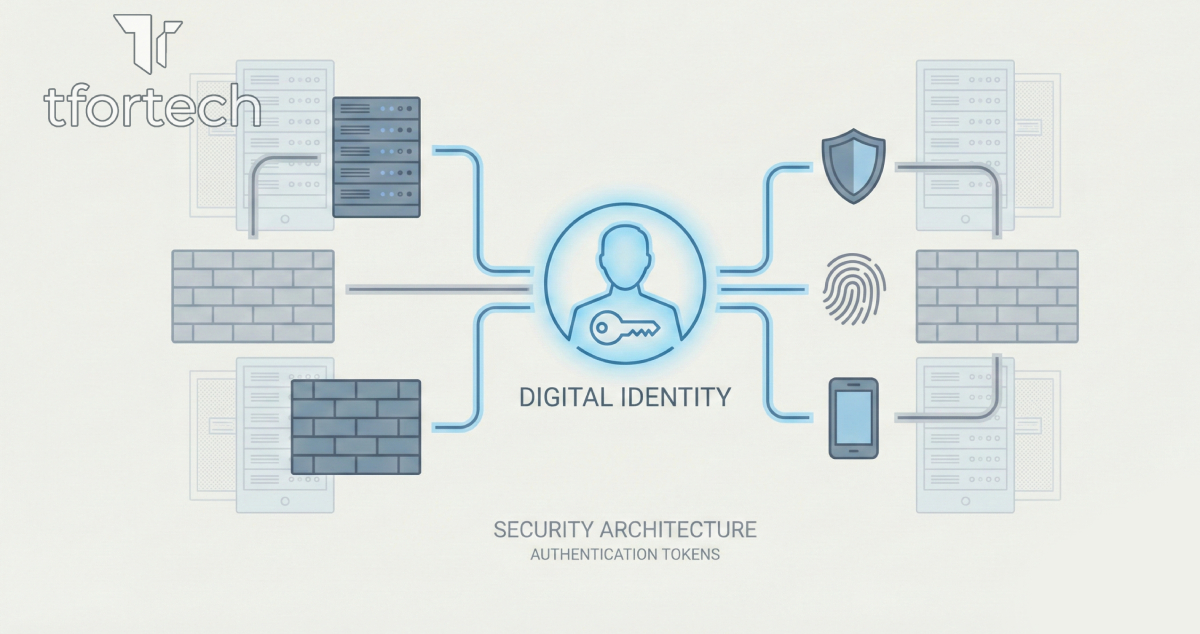
Identity quietly replaced the perimeter
Traditional systems were built around a simple assumption:
if you’re inside the network, you’re trusted.
That assumption no longer holds.
Modern environments are spread across cloud platforms, SaaS tools, remote devices and third-party integrations. The idea of a clear “inside” barely exists anymore.
What decides access now isn’t location.
It’s identity.
Who you are.
How you authenticate.
What device you’re using.
Where you’re connecting from.
What you’re trying to access.
The network didn’t disappear.
It just stopped being the gatekeeper.
Compromised accounts don’t look like attacks
One of the most dangerous aspects of identity-based incidents is how normal they appear.
From the system’s point of view, everything checks out:
-
the login is valid
-
the password is correct
-
the session token is real
-
the permissions are allowed
There’s no obvious breach.
No broken firewall.
No alarm screaming for attention.
Just legitimate access used by the wrong person.
That’s why identity compromises often go unnoticed for weeks, sometimes months.
Nothing crashes. Nothing fails. Everything works — until it suddenly doesn’t.
Permissions age faster than systems
Servers get patched.
Applications get updated.
Accounts accumulate.
Over time, access quietly expands:
people change roles, temporary permissions become permanent, admin rights spread, shared accounts survive, old integrations stay connected long after their purpose is forgotten.
No single permission looks dangerous on its own.
But identity risk is cumulative.
Every extra privilege increases the blast radius of a single compromised account.
Most environments aren’t broken.
They’re simply over-entitled.
MFA helps, but it doesn’t close the story
Multi-factor authentication is essential.
It raises the baseline and stops the simplest attacks.
But it doesn’t solve everything.
It doesn’t protect against token theft, session hijacking, compromised recovery emails, malicious OAuth permissions or social engineering during password resets. And it does nothing to explain why a user has more access than they should in the first place.
Identity security isn’t about ticking boxes.
It’s about understanding access, limiting it, and continuously reviewing it.
MFA is a layer — not the foundation.
Service accounts are the quietest risk
Human accounts get attention.
Service accounts rarely do.
They often don’t expire, don’t use MFA, have broad permissions, are poorly documented and are shared across systems.
When a service account is compromised, nothing visibly logs in. Nothing looks wrong. Things just start behaving strangely.
Identity security isn’t only about people.
It’s about everything that authenticates.
Identity failures are hard to undo
When infrastructure breaks, you rebuild it.
When identity breaks, recovery is slower and messier:
permissions need to be reviewed, sessions revoked, tokens invalidated, trust relationships reset and audit trails reconstructed.
Restoring access is easy.
Restoring trust is not.
That’s why identity incidents are expensive — not because of the initial access, but because of what follows.
Organisations invest heavily in infrastructure security.
But infrastructure rarely fails first.
Identity does.
Accounts linger.
Permissions spread.
Tokens persist.
Ownership fades.
Security doesn’t collapse with a dramatic breach.
It erodes quietly through access.
And once identity is compromised, everything built on top of it becomes unreliable.