Why Backup and Disaster Recovery Matters More Than Most UK Businesses Realise
Most business owners in the UK do not think about data loss on a normal day. The focus is always on clients, revenue, meetings, deadlines, everything that feels visible and immediate. Data protection usually sits somewhere in the background, something assumed rather than actively considered.
But the reality in the UK today is very different.
On average, thousands of small and medium sized businesses experience some form of data disruption every single day. Cyber security reports across the UK consistently show that a large percentage of SMEs will face at least one serious data loss incident every few years. It is not a rare scenario anymore. It is routine business risk.
And it rarely starts in a dramatic way.
In one case, a small finance company in London lost access to its entire shared environment after a simple phishing email was opened by one employee. Within minutes, files began to encrypt across the network. By the next morning, over 12 years of client records were inaccessible. The business had no usable backup system in place and spent nearly two weeks rebuilding critical data manually while operations were partially shut down.
In another case, a retail business in Birmingham estimated losing close to 18,000 pounds in revenue over just three days of downtime after a cloud sync error duplicated and corrupted their product database. Everything looked normal until customers started reporting missing orders and incorrect stock data.
These are not extreme cases. They are everyday scenarios for businesses that rely on digital systems but do not have proper backup and disaster recovery in place.
The most common misunderstanding is that cloud platforms such as Microsoft 365 automatically protect everything. In reality, they are designed for availability, not full recovery. If a file is deleted, overwritten, or encrypted, recovery is often limited by time windows and retention rules. Once those limits pass, the data is effectively gone from a business perspective.
What makes this more critical is how fast the impact spreads.
A company can go from normal operations to full disruption in less than one hour. Sales teams cannot access customer data. Finance departments cannot issue invoices. Project delivery stops. Communication slows down. And what initially looks like a technical issue very quickly becomes a financial and operational crisis.
Recent UK industry data suggests that even short periods of downtime can cost SMEs anywhere from 2,000 to 8,000 pounds per hour depending on the sector. For some businesses, especially those with strict service level agreements, the impact is even higher when reputational damage is included.
The difficult part is that recovery after the event is always more expensive than prevention. Emergency IT support, forensic analysis, system rebuilding, and data reconstruction often cost several times more than implementing a proper backup strategy in the first place. Yet most businesses only realise this after they experience it once.
This is where backup and disaster recovery becomes essential, not optional.
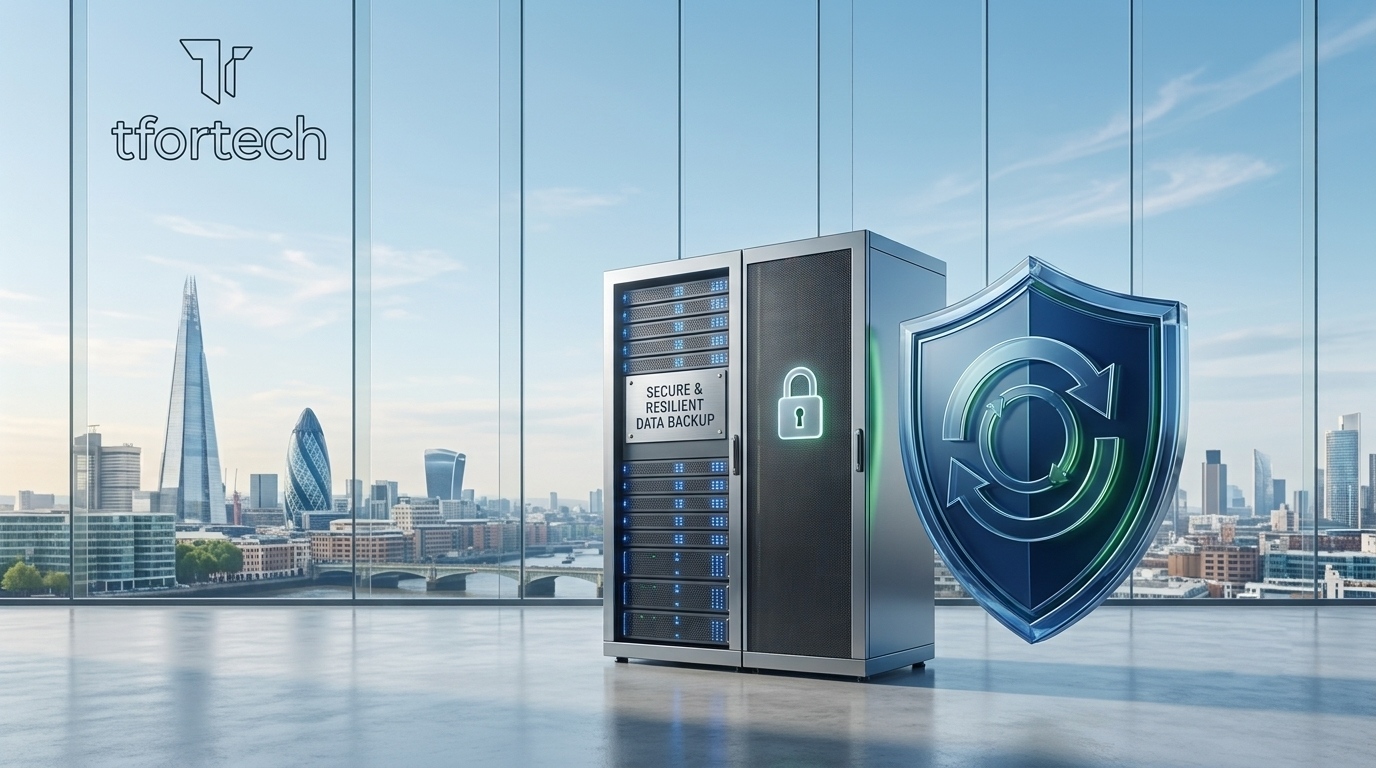
Because when it is done correctly, everything changes. Instead of uncertainty, there is a defined recovery point. Instead of panic, there is a process. Instead of rebuilding from scratch, systems are restored to a known safe state within a controlled timeframe. The difference is not just technical, it is the difference between business continuity and business interruption.
We live in a data driven economy now. Every transaction, every customer interaction, every internal process depends on information being available at the right time. When that data disappears, even temporarily, business stops functioning in a meaningful way.
That is why at Tfortech Technology we focus on making backup and disaster recovery simple, practical, and cost effective for UK businesses. Not oversized enterprise systems that are expensive and complex, but right sized solutions that actually fit how small and mid sized companies operate.
In many cases, the cost of proper protection is far lower than most business owners expect. Often it is comparable to a small monthly operational expense, far less than the cost of a single day of downtime or even standard business insurance premiums. The goal is not to over engineer the environment, but to make sure that when something goes wrong, the business can recover quickly without financial shock.
Because in the end, data is not just files or systems. It is the business itself. And in today’s world, losing data does not just slow a company down, it stops it completely.
The only real question is not whether an incident will happen, but how prepared the business is when it does.